


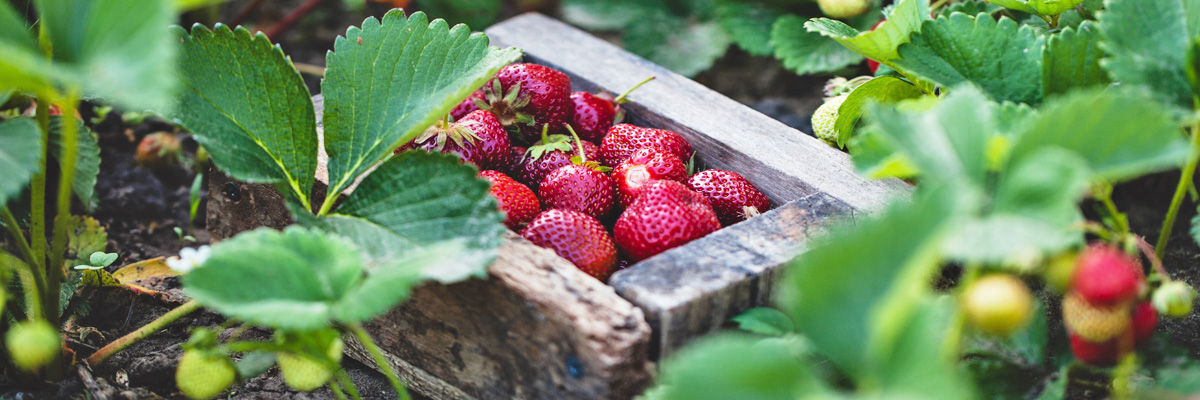
If there is a fruit with an irresistible appearance, a pleasant smell and a delightful taste, which is at the same time healthy and even medicinal, then it is undoubtedly the strawberry. These berries are full of surprises. Strawberry thrives in different pedological and climatic conditions. It can be planted in continental lowlands up to 1000 m above sea level, as well as on different types of soil. It is grown very successfully in our country and many producers have decided to plant this type of fruit in recent years.
PRODUCTION METHODS
Two strawberry productions are known in our country, in a closed (protected) area and in an open field. The cultivation technology is almost identical, which is why our producers often choose both, i.e. a smaller area under greenhouses and a larger area outdoors. However, there are manufacturers who do only one production. The only difference in these two productions is that the ripe strawberries in the greenhouses arrive earlier, therefore the earnings are higher and it ends with the beginning of the strawberry harvest outdoors. Those producers who have both productions have the possibility of placing strawberries on the market for a longer time.
The very goal of all agricultural production is to obtain quality fruit and a higher yield. This is achieved through intensive production.
First and foremost is proper preparation of the plot, basic fertilizing, installation of banks, foil and fertigation system (drop by drop), selection of varieties as well as frigo hedges or hedges from container production.
PREPARATION FOR PLANTING
If the problem is perennial weeds, it is recommended to apply a herbicide based on phligosat-Glifomark (6-12 h/ha) at least 3-4 weeks before planting. On the plot where strawberries are planted, the pre-culture of foreign grains is best, so that there is enough time to prepare the soil.
Soil preparation begins with plowing to a depth of 30-40 cm if it is a loamy-sandy soil. If the soils are somewhat “heavier”, plowing to a depth of 50 cm is recommended.
After plowing, there is fertilization with organic (manure) and mineral fertilizers, as well as calcification if necessary, based on the chemical analysis of the soil and the recommendation for fertilization, which is mandatory before planting. Instead of manure, we recommend 1.2-1.5 t/ha of BIOFERT 4:3:3 , pelletized, sterilized chicken manure. To raise the pH value, use pH PLUS, 100 kg to raise the value by 0.1 . Regarding NPK fertilizers, 70-100 kg of N, 50-80 kg of P2O5 and 120 kg of K2O are necessary for a yield of 20 tons. Then follows the milling of the soil. By milling, the soil is pulverized, from a powdery to a fine granular structure, to a depth of up to 15 cm.
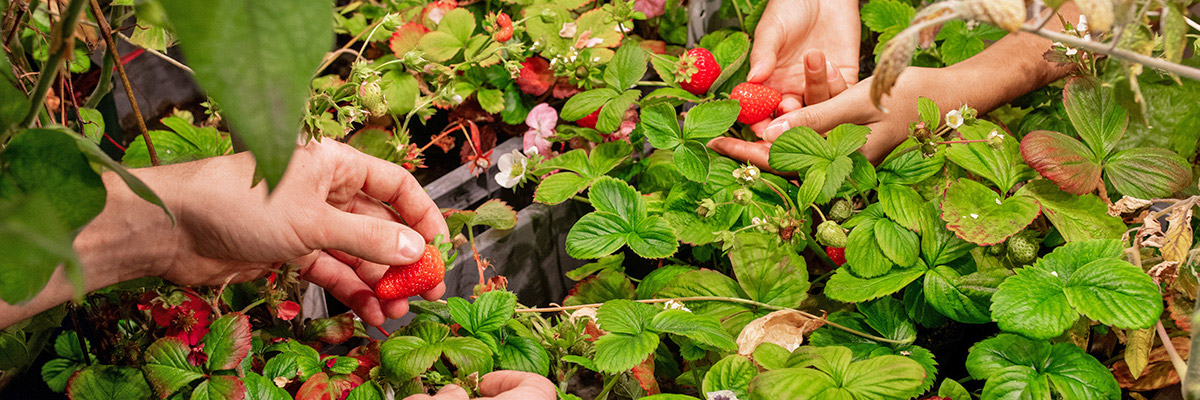
After milling, banks are made, tapes for drip irrigation are placed and finally polyethylene film (0.05-0.07 mm). The width of banks, depending on the choice of production, can be from 30-90 cm, and the height from 20-40 cm. With this method of cultivation, 35,000 – 42,000 strawberry seedlings /ha can be planted, which enables an average yield of 20 to 30 t/ha.
Planting of new strawberry plants is usually done with frigo or green hedges, and at the end of July, beginning of August. When planting, take care of the planting depth. It is best that the neck of the root remains up to 1 cm above the ground.
The best reception during planting is achieved with hedges planted immediately after removing the rootstock. If a long time has passed from removing the hedges to planting them in a permanent place, it is necessary to refresh them by spraying them with water, and keep the stems in water for 12 – 24 hours.
Immediately before planting, the vines should be examined, damaged, rotten or dry ones should be discarded, dry veins should be refreshed by pruning, and excessively long ones should be shortened by 1/3 of their length. It is preferable to disinfect and protect strawberry hedges prepared in this way before planting (immersion in a Funomil solution or immediately after planting by releasing the solution in a combination of Funomil, Fosko and Proplant through a drop-by-drop system).
STRAWBERRY FEEDING PROGRAM
For rooting, feed FITOFERT KRISTAL 10:40:10 1h/ha + FITOFERT HUMISTART 0.5 ml/plant through the system, and repeat in 7-10 days.
For the formation of bokor: FITOFERT KRISTAL 20:20:20 1g/ha + FITOFERT HUMISUPER PLUS 0.25 ml/plant , twice every 10 days.
Next year, when the growing season starts, clean the strawberries and leave 4-5 trees (bokora) per case.
Fertigation feeding (through the drip system):
FITOFERT KRISTAL 10:40:10 1h/ha + FITOFERT HUMISTART 0.5 ml/plant , twice with an interval of 10 days. After the movement of the leaves and the formation of buds: FITOFERT KRISTAL 20:20:20 2g/ha + FITOFERT HUMISUPER PLUS 0.25 ml/plant twice, for 10 days.
Calcium-Nitrate ( FITOFERT KRISTAL Ca-NIT ) must be given once a week in a dose of 1g/plant between two feedings.
FITOFERT MAGNI CAL B 0.25 ml/plant should be released by fertigation when the fruit set begins and during the harvest 3-4 times.
Intensive flowering and fruit formation: FITOFERT KRISTAL BERRY 1g/plant + FITOFERT HUMISUPER PLUS 0.25ml/plant every 7 days.
Beginning of ripening: FITOFERT KRISTAL 4:10:40 1 g/plant + FITOFERT KRISTAL BERRY 1 gr/plant . Repeat 1-2 times during harvesting.
After harvesting: FITOFERT KRISTAL 20:20:20 1 g/plant + FITOFERT KRISTAL BERRY 1 g/plant
Foliar feeding (through the leaf):
Vegetation movement: FITOFERT BIOFLEX – L 2 l/ha + FITOFERT HUMISTART 2.5 l/ha
Intensive growth: FITOFERT BIOFLEX – L 2 l/ha + FITOFERT BORMAX 20 1 kg/ha
Flowering: FITOFERT HUMISTART 3 l/ha + FITOFERT AMINOFLEX 2 l/ha
Intensive flowering, fruit formation: FITOFERT HUMISTART 3 l/ha + FITOFERT CALCIJUM ORGANO 30 2 kg/ha
Pouring fruit: FITOFERT HUMISUPER PLUS 3 l/ha + FITOFERT MAGNI CAL B 3 l/ha
Beginning of ripening and during harvest: FITOFERT K-COMPLEX 20 2.5 l/ha + FITOFERT CALCIUM ORGANO 30 3 kg/ha
After harvest: FITOFERT HUMISTART 2.5 l/ha + FITOFERT COMBIVIT 14 2 kg/ha
OUR ADVICE
Following our recommendations for the feeding program and the recommendations of our agronomists from the expert plant protection service give your plantation the opportunity for serious reproductive potential and the fulfillment of qualitative and quantitative norms when it comes to intensive strawberry production both outdoors and in a protected area.
Contact our professional service and be satisfied with the yield and quality of your strawberries every year.