


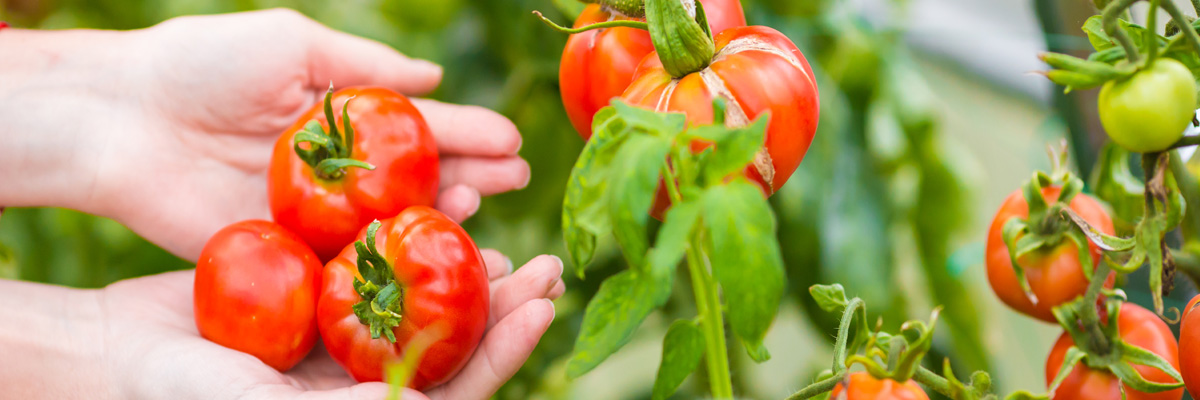
A better profit is also imperative in the production of tomatoes in a protected area, and this plant is certainly one of the most rewarding when it comes to intensifying production. Certainly, with the precondition that all the necessary steps in the production of seedlings, planting and overall nutrition and protection technology have been followed.
The key thing is to provide the plants with the maximum amount of nutrients in all phenophases of development, so starting with the basic tillage, up to 700kg/ha of the complex fertilizer SQM Qrop Complex 12-6-24, or a combination of 350kg each of 12-10-18 and 12-0-46 , is obtained, which gives the formula 12-5-32, which is very similar to the total needs of tomatoes. These complex nutrients are characterized by top quality and purity, and they do not contain chlorine or sulfur. As an alternative to barnyard manure, apply organic pelleted chicken manure – Biofert Green in a dose of up to 2000 kg/ha. If the soil has a lower pH value and no carbonates (there is no foaming reaction of sulfuric acid), 300-400 kg/ha of the pH Plus product should be added to it – otherwise, 100-200 kg/ha.
Bank formation: Protection and feeding of tomatoes before planting
The formation of banks, i.e. beds, is mandatory on more water-resistant and heavy types of soil.
Before the formation of the banks, or during that operation, the soil insecticide Force 1.5 G (7-8 kg/ha) is applied, with a very long repulsive effect on harmful insects, which protects the plants from the attack of plant pathogens from the soil (later occurrence of wilting).
The mentioned nutrients can be added directly to the banks, but with about a 30% reduced amount compared to the treatment of the entire area.
Due to more light, clean air and easier manipulation, the distance between banks in greenhouses should be at least 1.7m. Thus, only 4 banks can fit in an 8m-wide facility.
A density of 2.5-2.7 billion/m 2 is suggested for early planting dates (and late summer) as well as for more vegetative (lush) tomato hybrids, while in later periods and for more generative hybrids, significantly higher densities of up to 3.1 billion/m 2 are applied. On the mentioned 4 banks in the 8m wide greenhouse, the plants are planted at 18-19 cm in a row, and then when they grow, they are separated into two wires above each bank in a “V” shape, according to the principle – one plant on the left, one on the right…
The fertigation system must be adapted to the type of soil (with a larger distance between the drippers on heavier soils and a denser arrangement of emitters on lighter soils). Its purpose is the correct and even redistribution of the nutrient solution to all plants.
A well-nourished seedling should have no more than 4-5 true leaves and must not have developed flower elements on it, with noticeable yellow petals.
If it is a container seedling, those plants should be planted with cotyledons and only a few true leaves, and the root must be white. If it starts to atrophy, it becomes a good substrate for saprophytes and other harmful microorganisms.
Top dressing of tomatoes during planting
The optimal date for planting should be adapted to the type of facilities and technology, but it is certainly a universal recommendation – sow later, plant earlier .
During planting itself, 2-2.5 g/plant are applied through the drip system. modern formulation Fitofert Energy Root 5-55-10 , which is enriched with numerous biostimulators and increased content of microelements. An alternative is Fitofert Crystal 10-40-10 in the amount of 3-5g/plant. along with which FitoFert BioFlex L (a powerful biostimulator that supports plant development in the initial stages of development) is applied in the amount of 5l/ha once.
As a preventive measure against attacks, apply the systemic insecticide Amos or Actary at a dose of 1 kg/ha by watering. Tereki (200g/ha) is an insecticide with a wider spectrum of action, which acts in addition to lice on thrips, but also on the tomato moth (Tuta absoluta). If a nemato-insecticide is necessary, which works on all harmful insects, apply Vidate (10l/ha) . With the last two products, it is necessary to regulate the pH to 5-5.5 using the pH Green product. These pH values are normally used in hydroponic tomato production.
If the plants are planted with open flowers, and difficult production conditions occur, they must be removed partially (a couple of flowers from the first bearing branches), or completely (entire first bearing branches), if the plants are heavily burdened.
Top dressing of tomatoes after planting
Initially, after planting, the plants should be kept without irrigation for as long as possible for better rooting. On heavier soils, it can be as long as 30 days.
In that period, foliar feeding treatments should be carried out every 7 days (later in the afternoon);
Humistart 0.5% + Magni-Cal B 0.3% in sunny weather,
Humistart 0.5% + Bioflex L 0.2% on cloudy days
Occasionally include systemic copper that has no harmful effect on the flower;
– foliar Talocuper in a concentration of 0.2% ,
-fertigation Amino Copper 8 (5l/ha)
These products, in addition to preventing phytopathogens, regulate plant turgor (cell pressure) and reduce curling of lower leaves on tomatoes.
At the time of fruit setting, use a biostimulant product and boron Bioflex L 0.25% + Bormax 20 0.2%.
Apply Firofert Quatro in a concentration of 0.4% in a couple of treatments for a couple of weeks at the beginning of the growing season. (strong PK formula 25-20, all essential trace elements, very low EC of 0.1Ms/cm 2 . This SAR (SystemicAcquiredResistance) product induces systemic tolerance of cultivated plants to phytopathogens.
Preventive protection and feeding of tomatoes
A complete proposal of protective measures and compatible foliar supplements can be found in the special edition of Agrosvet, the expert magazine of Agromarket’s Professional Service, number 101 from January 2020. The above measures are of a preventive and indicative nature.
Foliar treatments in the initial stages of development should be carried out with 150-200l/ha of water, while when the plants are in full habit, more than 800l/ha should be used.
At the time of intensive plant growth , FF Kristal Tomato 12.5-6-31, Active 15-5-33 are used as the main formulation, necessarily with Ca-Nit in the beginning, usually in a ratio of 2:1, and later on less and less calcium. Of the two new formulations from the Energy product line Complete A 14-7-15+14CaO+ME and Complete B 13-8-24+5CaO , the second one is more suitable for tomatoes. The only thing missing from these new formulations is magnesium, which can be replaced with the product Magni-Cal B initially, and later with Mg-Max .
Proper use of water-soluble nutrients
For the proper use of water-soluble nutrients, it is necessary to apply a lower concentration of crystals in sunny and warm weather, and a higher concentration in cloudy and colder weather, and the average is g/1l (0.1%).
In the case of tomatoes, the thickness of the stem should be monitored at 20-1k cm from the top of the plant, and if it is thinner than 1 cm, the amount of nutrients should be increased, which can range up to 3 g in total per plant from release to release. In the beginning it is for about 10 days, and later with large fruits and for 2-3 days. If the tree is too thick at the top, in addition to a temporary reduction of nutrients (especially nitrogen), the leaf across from the last flowering branch at the top can be removed at the base. This measure restores generativity to the plant.
The most common deficiencies on plants are primarily associated with calcium (unevenness on the leaves) or magnesium (lenticular lighter chlorotic spots framed by leaf veins), and potassium deficiencies are unfortunately only seen in the plate. The so-called white veins, or the presence of cellulose trains in the fruit, can be avoided with the proposed technology from the very beginning of production. One particularly effective potassium-based product stands out for its effects, and that is FF K-Complex 20.
This unique organic potassium can be used by fertigation in a dose of 5-10l/ha as well as foliar in a concentration of 0.2% with organic calcium (Ca Organo 30 0.2%) at the same time and without a withdrawal period. This combination ensures better quality and longer durability of the product.
The yellowish-green, lighter color of the tops of the plants is an indicator of the vitality and rapid growth of the plants.
Deformity of the leaves and their reduced photosynthetic surface are a frequent phenomenon if producers treat the entire plants with hormones for fertilization, which is certainly not recommended, but we are on the side of bumblebees as pollinators, which increase yields by up to 30%.
On lighter soil and with less organic matter (sandy and light), it is recommended monthly through the FF Humiflex system, or Humisuper Plus in the amount of 20l/ha.
Due to a lot of hard waters with a lot of bicarbonate throughout the region, which are used in tomato fertigation, regular use of pH Green is extremely necessary, and most often in the amount of 150-300g/1m 3 of water, or per kg of usable mentioned crystals.
In cloudy weather, the amount of water should be reduced and watering should be carried out as rarely as the conditions allow. On sunny days, if necessary, the parrot should be irrigated daily and constantly with a nutrient solution, in order to improve the yield and quality of the fruits, and thus the final profitability.